
Park Quest

ParkQuest is a story-driven AR play system for Wood Yard Park. It transforms the underused graffiti zone into an imaginative, social, and age-responsive play space for children with different social and emotional needs.
Problem
Children use the park unevenly: older children quickly lose interest in the playground, the graffiti zone remains underused, and socially withdrawn children lack a low-pressure way to join play.
Goal
Use AR to turn the graffiti zone into an imaginative play journey that supports exploration, storytelling, and low-pressure social connection.
Result
Prototype testing indicated stronger engagement and smoother co-play.
3-6 x Longer engagement, 20% to 80% collaboration completion.
Timeline
09/2023-11/2023
Responding to a Prompt
This project was initiated by a design prompt:
Activate Wood Yard Park through an Augmented Reality intervention.
Research
Upon receiving the prompt, I first conducted preliminary observations at Wood Yard Park to understand the park's basic situation.
Current Experience
Preliminary observations reveal a significant disparity in participation levels within the park:

80% of playground users are ages 2–4; children 5–8 quickly get bored, switch to self-invented games in the playground, and end up competing for space with younger kids.
1
Graffiti Zone Retention?
2
Age Gap & Unmet Needs?
What cognitive and social needs do children aged 4+ have that existing facilities can't meet?
3
Social barriers?
For socially withdrawn children, what specific barriers must they overcome before joining in?
What kinds of "social scaffolding" can we provide?
4
AR as a Bridge?
How can AR act as a "bridge" that both balances foot traffic across zones and catalyzes natural social play?
Hear it more from the children and caregivers
I conducted qualitative research across three child–caregiver groups, combining caregiver interviews with naturalistic observation to examine park behavior patterns, participation barriers, caregiver concerns, and responses to AR experiences.
Research Scope & Trade-off
Constraint
Within the eight-week timeline, direct, age-appropriate sessions with children required additional preparation beyond the available time.
Priority Decision
I prioritized caregiver interviews and naturalistic observation to capture observable behavior and participation context while preserving time for prototyping and testing.
Research Synthesis
I mapped caregiver perspectives and children’s observed behavior separately, then compared them to identify recurring patterns, differences, and shared design opportunities.


Jason · 5 years old - The Park's “Quiet observer”

What is he resisting?
The dual pressure of initiating interaction while meeting parental expectations.
The moment of success?
When he brought a toy, others approached him—allowing him to join social interaction without initiating conversation.
Leo · 6 years old - Story creator and challenge seeker

His mind is eager to “Invent rules and stories,” but his body can only “repeat the slide.
Jason and Leo reveal two contrasting but complementary participation styles: one initiates through challenge and creation, while the other hesitates but longs for connection and belonging.
This points to a design opportunity: creating a play system where one child’s initiative becomes another child’s invitation to join.
Design Goal
Create a flexible and inclusive park play system that helps children with different social and play needs join more easily, stay engaged, express creativity, and build connection, while helping caregivers feel confident in screen-based interaction.

Synthesizing User Needs
Concept
ParkQuest transforms the underused graffiti zone into a story-driven AR play system where children discover characters whose "differences become strengths", follow missions that extend into the park, and enter shared play through exploration, imagination, and low-pressure social interaction.
Before

Underused graffiti zone
After

Continuously Generating Imagination, Opportunities for Social Interaction
Design - Early experience flow
Storyboard
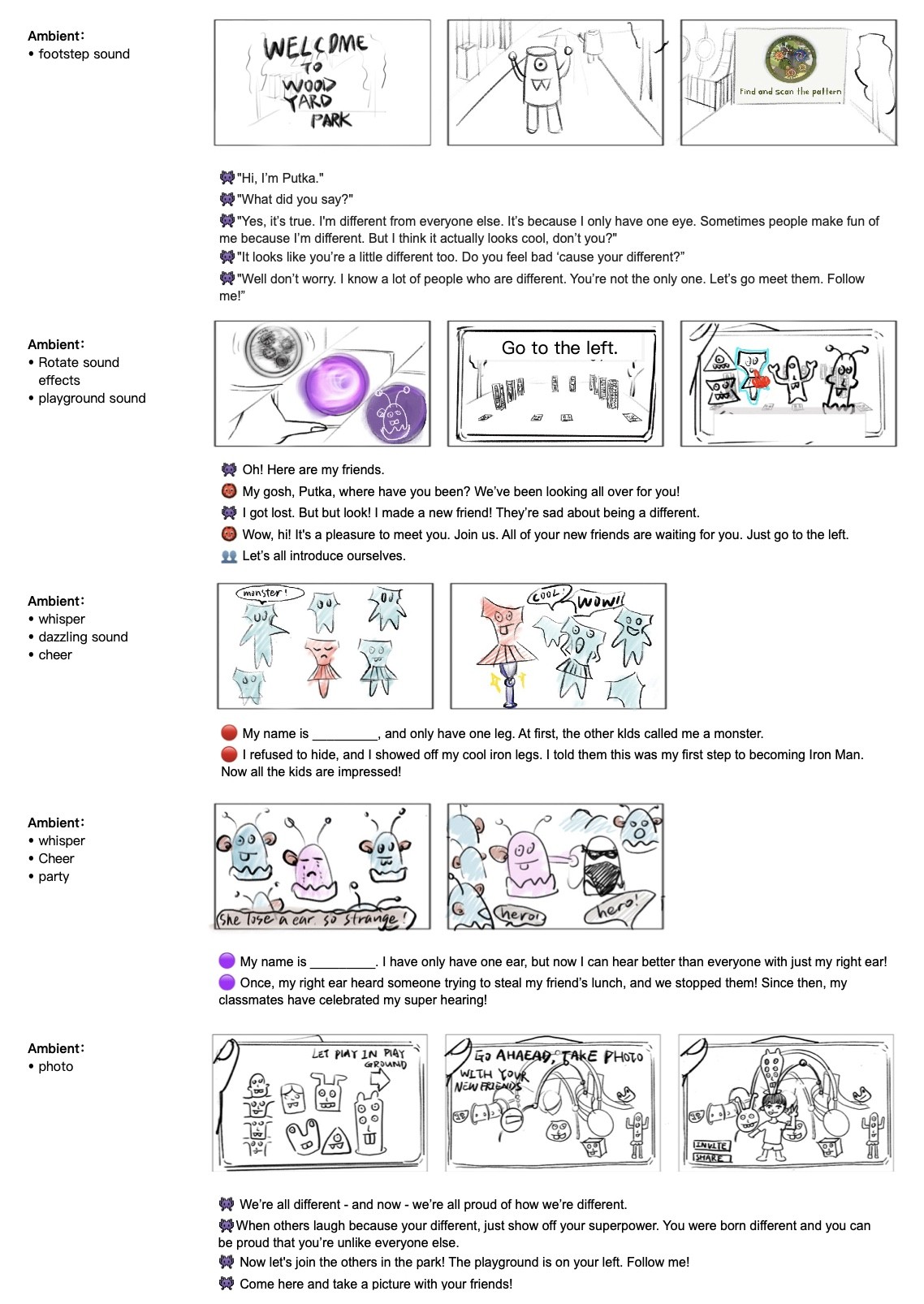
Scan and meet character
Location-based Trigger
Guided by the story character, children explore the park to find hidden patterns. Each scan unlocks a new AR story.


Receive mission and explore
Educational Stories
Stories in which two different groups of characters reveal how their weaknesses turned into their strengths.

Invite and share
Group Photo
Back at the park, the task is to invite other children to join in taking a group photo with the AR characters.

Evaluation & Iteration
To evaluate whether the prototype supported independent exploration, sustained engagement, emotional understanding, and low-pressure social interaction, I conducted iterative testing using storyboards, printed prompts, video prototypes, and AR simulations with children and caregivers.
Participants 8 children (5–8 yrs)
Methods Storyboard + AR prototype + Think-aloud + Observation
Metrics Completion rate · Engagement time · Social interaction · Parent intervention
Evaluation Goals
🧭
Spatial agency
Can children navigate the full loop independently? Do they follow prompts correctly?
⏰
Attraction Duration
Do they stay longer at the graffiti zone—or lose interest quickly?
💓
Emotional resonance
Can they grasp "flaw as strength"?
🤝
Social Breakthrough
Do they seek less help from parents? Are socially withdrawn children approached more by peers?
What worked:
✅ Children were able to follow the visual cues independently with minimal adult guidance.
✅ The unlock mechanics effectively sparked their engagement and excitement.
✅ Caregivers responded positively to the imaginative and collaborative story content.
What need iteration:
Narrative — passive audio lost attention after ~90s
Social — verbal invitations created hesitation for withdrawn children
Navigation — arrow guidance lacked clear arrival confirmation
1
❌ What Failed
The narrated story lost children's attention after about 90 seconds. They wandered, tapped to skip, or asked when they could play.
✅ What Worked
The monsters sparked curiosity. Children attempted unscripted interactions with characters.
💡 Insight
Auditory input is insufficient to sustain cognitive engagement in young children. They need a way to get involved in the story.
Turn story listening into story changing.
Tasks gave children a role inside the story, turning them from listeners into participants.
Before: Passive Listening
The monster tells how its mocked flaw became a strength.

Low agency
90s avg. attention
8/10 distracted
3/10 exited early
After: Task-Driven Story
Children drag the power stone to give the monster a superpower, turning its flaw into a strength.

Story intervention
9/10 completed rounds
5-8 min engagement
3 asked to replay
✅ By allowing children to influence the story through action, engagement lasted 3–5× longer, with 90% completing all rounds and 30% asking to replay.
2
❌ What Failed
Withdrawn children could join when invited, but froze when they had to invite others.
✅ What Worked
AR monster attracted a crowd without anyone saying a word
— children gathered around the screen first, then started playing together.
💡 Insight
AR could create connection, but the trigger was wrong. Connection needed to be system-triggered, not child-initiated.
Turn "verbal invitations" into "doing something together".
We removed verbal initiation and replaced it with a shared physical task—so connection happens through action, not words.

Requires verbal invitation
5-10 min hesitation
2/10 completed collaboration

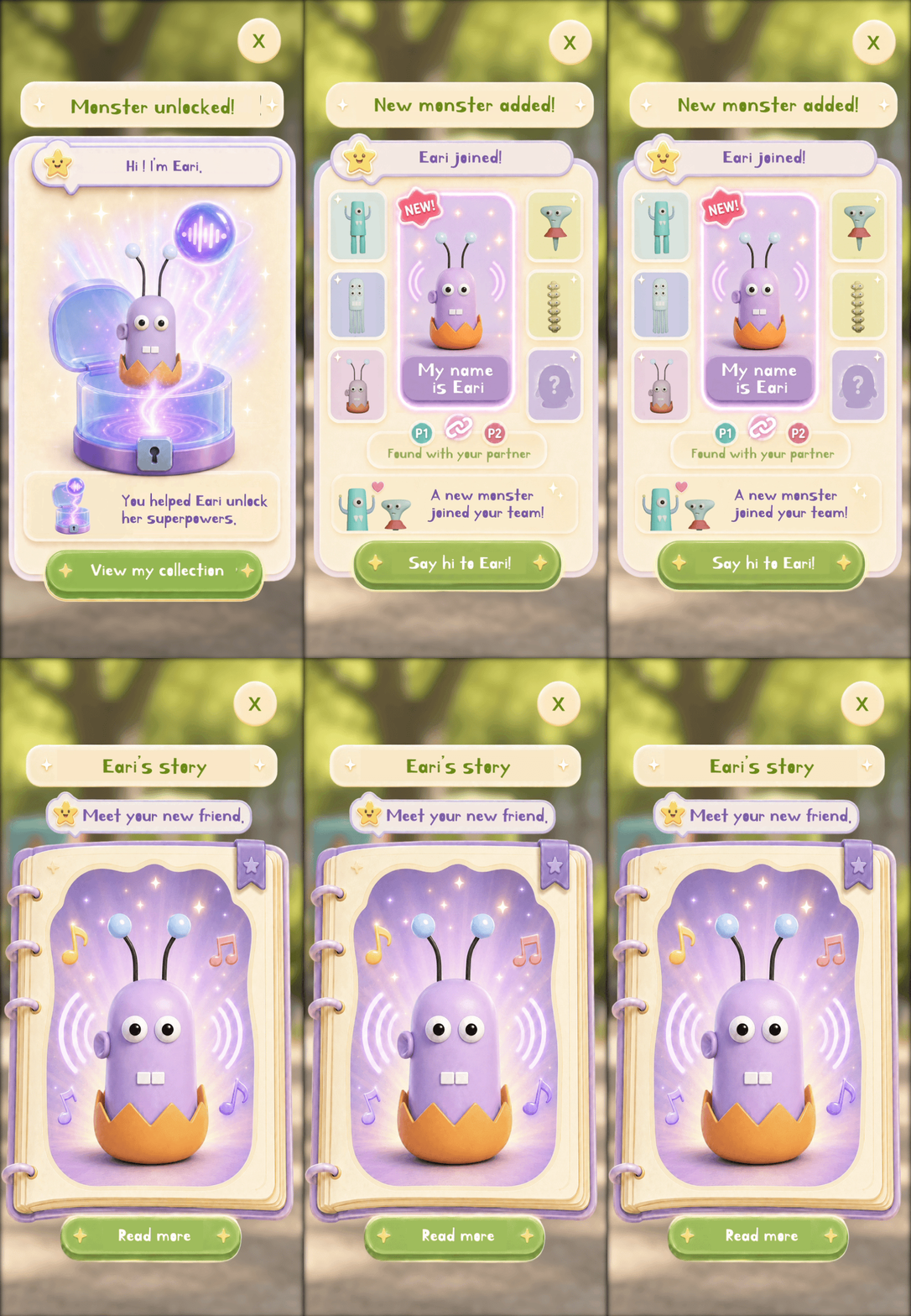
Natural Convergence
< 2min hesitation
8/10 Completed
✅ By shifting from child-initiated invitations to system-facilitated shared tasks, we reduced collaboration friction by 80% and increased completion rate from 20% to 80%."
3
❌ What Failed
The arrow guidance didn’t clearly show where to stand or how many steps remained, so children paused and looked for confirmation.
✅ What Worked
Children could follow arrows to get a general sense of direction
💡 Insight
Children did not only need directional guidance; they also needed clear arrival confirmation.
The character leads children forward and waits at the target spot.

3-5 min to locate target
Stopped before target
Needed intervention

< 1 min to locate target
Reached exact spot
No intervention
✅ We reduced mid-route confusion from 5/10 to 1/10 and eliminated the need for parental intervention.
Final Design
The underused graffiti zone becomes a space where imagination, collaboration, and connection happen—naturally.
Scan & meet a character → Complete task → Activate co-play pairing → Unlock hidden monsters → Celebrate with shared AR photo → Collect more monsters
Early Prototype Outcomes
Early prototype testing showed promising short-term signals: children stayed engaged longer and more participants completed the collaborative task. These results reflect a small prototype study - not real-world product impact.
3 - 6× longer observed engagement
Compared with the baseline activity under the same test conditions.
1/5 → 4/5 completed the collaborative task
From the photo-invitation prototype to the shared-unlock prototype.
Reflection
I learned that designing for children’s social connection is less about asking them to be social, and more about creating the right conditions for interaction to emerge.
For AR to be meaningful, it should not replace physical play. It should help children read the space, enter the story, and connect with others at their own pace.
Evidence Boundaries
Within the eight-week project, I prioritized caregiver interviews and naturalistic observation to capture real behavior while preserving time for prototyping and testing. This created two limitations:
Indirect access to motivation
Caregiver interviews provided context but filtered children’s motivations through an adult perspective. Observation showed what children did, but could not fully explain why.
Limited child-led validation
Story, reward, and replayability decisions were evaluated mainly through observed behavior rather than directly co-designed or prioritized with children.
Next Validation
Co-design Replayability with Children
Use age-appropriate activities to let children shape and prioritize story themes, collectible paths, and progression mechanics.
Scale Beyond Pairs
Test how three or more children can participate without reintroducing invitation pressure, exclusion, or one child dominating the experience.
Measure Sustained Field Use
Conduct longer-term field testing to examine repeat visits, engagement duration, collaborative play, and reliance on caregiver prompting.