
Nudge
Nudge is an app that helps apartment residents get practical assistance and casual companionship.
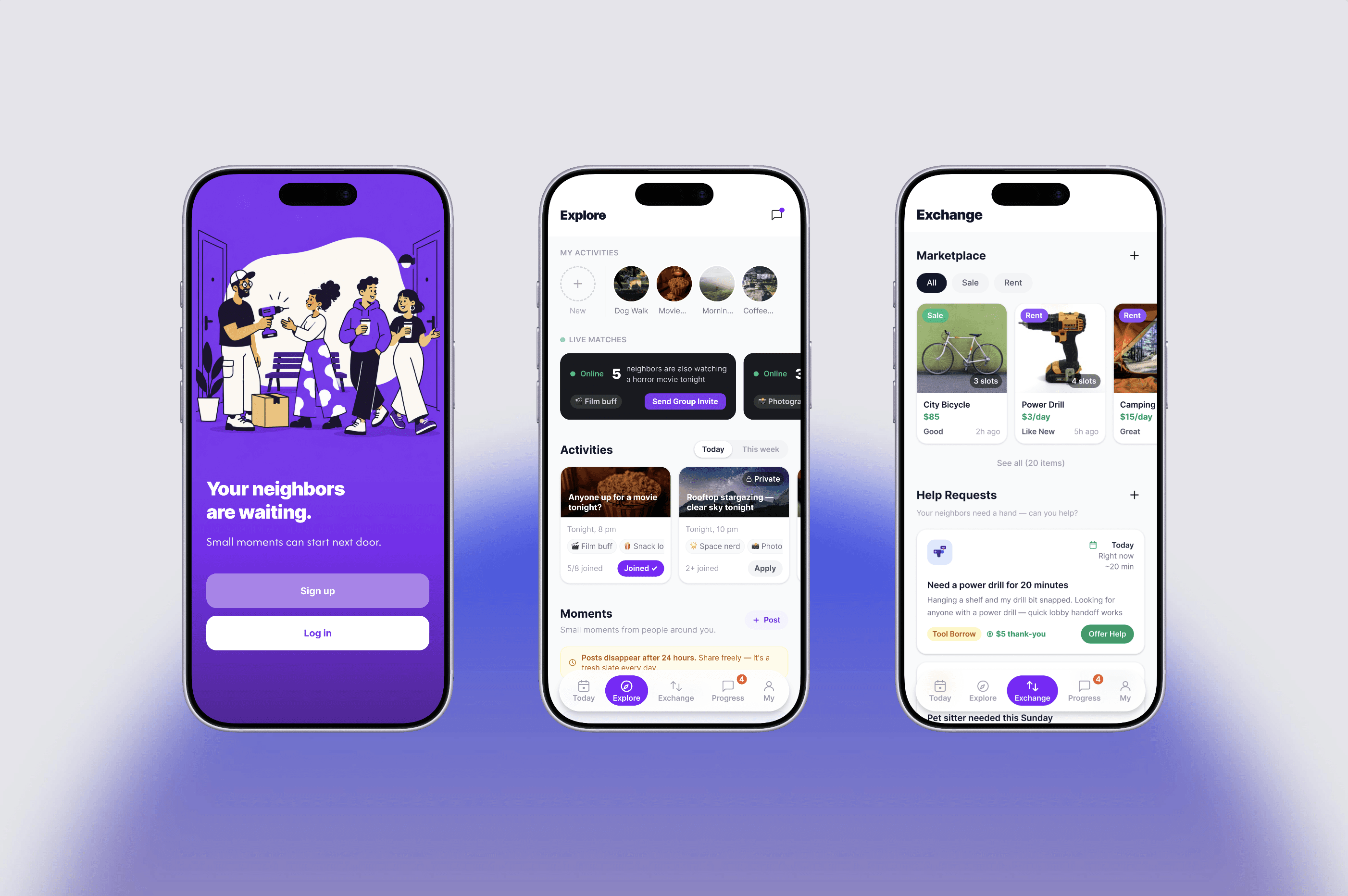
Nudge is an apartment community app that helps residents access timely nearby help and lightweight companionship—without prior closeness or ongoing social obligation.
THE PROBLRM
Apartment residents lived close to potential support, yet lacked a low-risk way to discover mutual fit and coordinate a clearly bounded interaction—without first building a personal relationship.
THE GOAL
Create a low-pressure, opt-in path for residents to discover mutual fit and coordinate temporary, purpose-bound interactions.
DURATION
3 months
2025
RESPONSIBILITIES
User Research · Concept Testing · Interaction Design · Prototyping · Usability Testing
TRIGGER
Living close didn't lead to connection

I lived in a 400+ unit apartment building, yet barely knew anyone. Everyday proximity produced repeated encounters but little interaction.
I INITIALLY ASSUMED
Residents preferred distance, and interpreted silence as disinterest.
THE CONTRACTION
One fire alarm challenged that assumption: the same neighbors who rarely spoke began connecting with almost no effort.
Maybe residents might lack a natural, low-pressure reason to interact?
WHAT MAKE ME THINKING ABOUT
What made connection feel natural during an emergency—but difficult in everyday life?
Was low interaction a lack of interest, or a mismatch between residents and existing opportunities?
❗️One observation couldn't reveal the full picture. I needed to find out whether it reflected a broader pattern - and what conditions shaped everyday interaction between neighbors.
PHASE 1
Initial exploration
RESEARCH GOAL
To determine whether the contrast I observed reflected a broader pattern, and understand residents' behaviors and perceptions of everyday neighbor interaction.
Behavior mapping
3 days, 150+ observations
Capture actual behavior in shared spaces.
Intercept interviews
15 residents, 5-10min
Compare observation with residents' own perceptions of neighbor life.
Platform analysis
past 3 months posts
Check whether the offline pattern also appeared online.
WHAT THE DATA SHOWED
Limited social interaction, higher engagement around practical needs
SHARED SPACES OBSERVATION
95% functional behavior
5% social
Supporting signal from building manger
"Amenities were often used for work or private parties, while resident events see little participation."
COMMUNITY PLATFORM RESPONSE RATE
40%
Complaints
35%
Marketplace
7%
Social / Events
Source: Potrero 1010 community website, three-month post and comment
SHARED SPACE BEHAVIOR
Residents mostly waited, collected packages, or worked, then left. The limited social interactions occurred mainly in the dog park, gym, recreation room, and rooftop terrace.
ONLINE BEHAVIOR
On the building’s community platform, practical posts received more responses, while activity groups saw lower participation - prompting further research into residents’ participation decisions.
WHAT INTERVIEWS COMPLICATED
Residents sought connection, but it rarely took hold inside the apartment.
15 Residents interviewed
11 of 15
No neighbor relationship
They don't know anyone in the apartment.
4 of these 11
Unmet intention
Wanted to know neighbors but had not succeeded.
7 of these 11
Stated disinterest
Said apartment socializing was not important to them.
But when I dug deeper…
Nearly half of these seven residents still used Nextdoor or Meetup to browse nearby events and community updates.
Low interaction did not have one explanation. Some residents wanted connection but could not initiate it; others rejected apartment socializing while still browsing local events and community updates elsewhere.
HOW THIS CHANGE MY RESEARCH
Phase 1 confirmed that low neighbor was common - but not whether residents experienced is as a problem.
I shifted Phase 2 from mapping interaction patterns to understanding the motivations and barriers behind them.
NEXT QUESTION
What made building interactions difficult to initiate or sustain?
Why did some residents seek connection outside the building instead?
PHASE 1
Uncovering What Residents Actually Need
RESEARCH GOAL
Among residents who showed some unmet or ambiguous desire for connection, I aimed to understand what shaped their willingness to engage with neighbors and what kind of neighbor relationship mattered in everyday life.
PARTICIPANTS
10 residents (6 phase 1 follow-ups + 4 new participants)
STAGE 1
I Realized I Was Framing the Question Too Narrowly
Residents expressed a desire for connection, yet often avoided socializing within their building. This contradiction made me realize that asking why they didn’t socialize was already narrowing the kind of neighbor relationship I was investigating.
METHODS
Semi-structured interviews · 20–30 min
Wanting Connection, But Avoiding Socializing
Even when residents wanted connection or companionship, many saw apartment socializing as high-cost and low-reward.
🏠
Home is for recharging
"I just want my own space after work."
🔐
Privacy & safety concerns
"After being harassed, exposing my address felt unsafe."
😅
Social events feel forced
"I don’t like awkward meet-your-neighbor events"
🫥
High turnover cuts investment
"Neighbors move often, I don’t want to invest in short-term relationships."
Some stopped trying altogether; others chose to meet their social needs outside the building.
The Contradiction Made Me Question My Framing
My initial questions may have unintentionally led participants to view neighbor relationships through a high-investment, friendship-like lens.
Participants kept associating neighbor socializing with high-investment behaviors:
🤡
Pressure to perform well
👤
Meeting strangers
ℹ️
Sharing personal information
🫂
Maintaining relationships
🔋
Time and emotional investment
Starting from “socializing” led me to investigate why high-investment relationships failed, rather than what residents actually needed from neighbor relationships.
Zoom out to Explore the Underlying Need
I stepped back to understand what a good everyday neighbor experience would look and feel like—on their own terms.
Ask
"Ideally, what would you want everyday life with the people around you in your building to feel like?"

Why residents avoided socializing?
Instead of …
STAGE 2
Defining the Desired Form of Neighbor Connection
With this broader framing, I explored when nearby connection felt useful, what kinds of interaction felt comfortable, and what boundaries residents wanted to maintain.
METHODS
Semi-structured interviews, Critical incident prompts, 5 Why's, Laddering / trade-off probing
WHAT RESIDENTS NEED FROM NEARBY CONNECTION
Many participants preferred a middle layer between neighborhood anonymity and friendship.

Available when useful, without requiring closeness or ongoing maintenance.
Bounded Familiarity
Recognize who lives nearby and develop enough trust to approach them when relevant—without implying personal closeness.
" I don’t need close friends. I just want to recognize who lives around me and know who I could approach if needed.
Ambient Reassurance
Feel that others are nearby and potentially reachable, even without direct interaction.
" When I get tired from working remotely, I want to go downstairs and take a walk with someone.
I don’t need to say anything—it’s enough just to know there’s someone else working nearby.
Practical Help & Resource Sharing
Ask for, offer, or exchange small forms of practical support without creating an expectation of ongoing reciprocity.
" If I buy too much at Costco, I’d like to split it with someone nearby.
It would be great if there were someone I could trust to help take care of my cat when I'm busy.
Activity-Based Companionship
Connect through shared routines or activities when desired, with friendship as a possibility—not an expectation.
" I’d grab coffee with someone nearby—I just don’t want it to feel like a date or a friendship request.
WHY DID LIGHTWEIGHT CONNECTION STILL FEEL DIFFICULT?
Safety, Privacy & Obligation Risk
Whether it was safe, how much information would be exposed, and whether it would create unwanted social obligations.
Relevance, Availability & Intent Uncertainty
Residents had little visibility into who around them shared a relevant need, interest, routine, or willingness to interact.
Initiation, Coordination & Closure Friction
Starting an interaction carried the risk of rejection, silence, or awkwardness, while arranging time, place, and a clear ending required additional effort.
CORE BARRIER
Residents lacked a low-risk way to discover mutual fit and coordinate a clearly bounded interaction
FIRE ALARM LOWERING INTERACTION COSTS.
Shared situation
Relevance was self-evident
Co-presence
Willingness didn't need to be visible
A natural topic
A foolproof opening line
No one hosted
No organizer burden
The alarm ended
No ongoing obligation
THE CONTRADICTION
Residents wanted clear boundaries and someone nearby they could trust, yet resisted the ongoing relationship work typically required to build that trust.
INSIGHT
Trust was a means, not the desired outcome.
Residents were not seeking relational trust as an end in itself. They sought reliable access to nearby support: someone they could safely reach out to for help or companionship and reasonably expect a response from.
HOW THIS GUIDED THE NEXT STEP
Explore how nearby support and lightweight companionship could become visible and safely accessible—without requiring residents to first build a personal relationship or accumulate interpersonal trust.
Turning research insights into a Design Direction
STARTING POINT
Apartment living already contains latent practical and social value within residents’ everyday overlaps.
Looking across observations, platform activity, and interviews, I found that apartment living naturally created recurring overlaps:
Practical needs
Package pickup
Tools
Pet care
…
Overlapping routines
Dog walking
Workout
Coffee breaks
Remote work
…
Shareable
resources
Unused items
Shared purchases
Tools or equipment
…
Shared situations
Spontaneous events,
Local info
…
These overlaps provide natural, legitimate reasons to interact.
What is missing is visibility into when they exist—and who is open to responding.
💡
OPPORTUNITY
Make relevant overlaps and mutual willingness visible and actionable.
EXPLORATION FOCUS
How might we make useful, low-pressure support and companionship visible and actionable through the everyday overlaps of apartment life—without requiring prior relationships, unnecessary self-disclosure, or ongoing relationship maintenance?
Ideation
Brainstorming from the HMW, I explored mechanisms across 3 barriers identified in research. Ideas were organized by interaction stage, then evaluated for user value, feasibility, and risk.
THREE DIRECTIONS
01 CONTEXT GAP
Make the right signals visible
Relevance | Availability | Intent
02 COORDINATION COST
Reduce the burden of starting
Initiation | coordination | Closure
03 PSYCHOLOGICAL FRICTION
Protect boundaries by default
Safety | Privacy | Obligation

OUTCOME
High-confidence mechanisms formed a shared baseline; high-impact, uncertain drivers became the variables used to build three contrasting concepts for testing.

CONCEPT TESTING
I compared three interaction models
3 concepts that combine feasible mechanisms with promising but untested ones across two scenarios - tool borrowing and casual companionship - measuring willingness to act, comfort with visibility, perceived coordination effort, and confidence in exiting the interaction.
METHODS
Moderated testing · 5 participants · Concept cards + storyboard · Wizard of Oz

TESTING FOCUS
VALUE & RELECANCE
Can resource exchange and lightweight companionship begin before neighbors have established a relationship?
WILLINGNESS TO ACT
Which model makes residents most willing to post, respond, or join?
PSYCHOLOGICAL SAFETY
What visibility, identity, consent, and closure safeguards make these interactions feel safe?
PRODUCT SCOPE
Should product entry be driven by resource access, light companionship, or both?
WAHT IT SUPPORTED
✅ Refundable deposits, return confirmation, and third-space handoffs increased participants’ confidence in higher-value item exchanges.
✅ Mutual opt-in and temporary, task-focused coordination made one-off help and lightweight activities easier to join.
✅ Clear, time-bound nearby signals and intent tags increased participants’ willingness to respond.
WHAT TESTING CHANGED
Concept testing revealed where the original mechanisms conflicted with higher-priority user needs. I used this evidence to retain the underlying value, revise the interaction model, or deprioritize the mechanism.

KEEP
Time-bound signals
Mutual opt-in
Temporary coordination + clear closure
Intent tags
Deposit-based Borrowing and Returning
CHANGE
Binary public/private → Tiered visibility
Uniform profile → Contextual trust cues
Single-match routing → Auto-recovery fallback
Invisible outcomes → Aggregated community feed
LEAVE OUT
Single-match dead-end dependency
Building-wide exposure for sensitive needs
Default full anonymity without accountability
Threshold waiting for lightweight borrowing
The concepts converged into two entry paths: resource access and lightweight companionship. Public-first discovery, user-controlled visibility, contextual trust cues, and privacy-safe activity signals form the core; Quiet Match remains optional.
Design
I refined the core flows through lightweight iterations, prioritizing critical user tasks, interaction clarity, and key trust-and-safety decisions before consolidating them into a high-fidelity prototype for testing.

USABILITY TESTING & ITERATION

FINAL DESIGN
From a nearby signal to a clear next step.
The final experience helps residents discover timely nearby support, assess relevance and basic accountability, coordinate with less exposure, and leave when the shared purpose is complete.

Make nearby support easier to notice.
Today
Prioritizes expiring requests, forming groups, and items available now.
Explore
Surfaces time-fit activities and shared intent nearby.
Exchange
Supports rentals, sales, and paid one-off help.

01 RELEVANCE
Match around shared intent.
Time-bound signals
Interest and status signals expire automatically after 3 hours, keeping matches current.
Live Matches
The system surfaces groups with overlapping time and intent—not a single opaque match.
Public fallback
Residents can still browse or create activities when no Live Match is available.


02 COORDINATION
Replace back-and-forth with mutually agreed-upon plan.
Key logistics are confirmed in the flow, keeping residents aligned:
Availability upfront
Owners set pickup slots; renters choose one..
Shared-space handoff
Avoid home-address disclosure.
Clear returns
Return details stay pinned, extension need approval.
Held deposit
Released after mutual confirmation; disputed stay on hold.
Design response: Reduces repeated scheduling, delayed replies, address exposure, and unclear responsibility.


03 PRIVACY & BOUNDARIES
Safer and lower-pressure experience - with clear boundaries
The public layer shows relevant context and basic trust cues. Contact starts by mutual opt-in and ends with the activity.
Verified, not fully anonymous
Aliases and system avatars are backed by resident verification.
Audience controls
Controlled visibility and entry; private preferences.
Optional icebreaker
Prompts ease firt contact.
Temporary space
Chat closes with the purpose.

04 COMMIUNITY & PRESENCE
Make the community feel alive - without a permanent feed
Moments helps residents notice one another through low-stakes sharing rather than another profile-building social network.
Rotating prompts
Featured Topics provide a concrete, low-effort starting point for residents unsure what to share.
24-hour expiry
Posts disappear after 24 hours, reducing pressure to maintain a public identity or lasting archive.

05 CONTEXTUAL TRUST
Build trust from relevant history
Shows verified completion history and transaction-specific feedback
Interaction outcomes
Recent results and feedback show how exchanges went.
Community activity
Completion totals show that real support is happening nearby.
Reflection
The project initially set out to help neighbors socialize. Research, however, revealed a more specific need: residents wanted reliable access to nearby help and lightweight companionship without first having to build personal relationships.
Nudge therefore evolved into a clearly bounded coordination system. Time and intent cues help residents assess mutual fit; context-specific trust signals provide enough confidence to act; mutual opt-in, structured coordination, and temporary spaces define how each interaction begins and ends.
EVIDENCE BOUNDARIES
LIMITED EXPLORATION
Within this three-month solo project, I completed one round of concept testing, refined the core flows, and conducted high-fidelity usability testing. This allowed me to focus on validating the primary flows but limited further comparison among alternative concepts.
DIRECTIONAL EVIDENCE
The usability study involved five participants. The results indicate patterns within the study but cannot represent the broader resident population.
PROTOTYPE VS. REAL-WORLD BEHAVIOR
Testing evaluated whether the flows were understandable and how participants perceived their value. It could not validate actual response times, repeat participation, cold-start dynamics, no-shows, disputes, or trust over time.
Next validation
Future work would focus less on adding features and more on testing whether Nudge’s core model holds across different residents, repeated use, and imperfect interactions.
BROADEN RESIDENT VALIDATION
Test the revised flows with a wider range of apartment residents to examine how trust needs, willingness to participate, and preferred boundaries vary across different living situations.
TEST REPEATED PARTICIPATION
Conduct short, multi-session studies to examine whether residents remain willing to respond after an initial interaction and how previous outcomes shape future trust and participation.
TEST BREAKDOWNS AND RECOVERY
Extend the prototype to cover unanswered requests, cancellations, no-shows, overdue returns, and disputes. Evaluate whether verification, deposits, handoff rules, and recovery paths provide enough clarity and confidence.